The AI value gap: why licenses aren't ROI
Where to start
Ask a room full of executives if they're measuring the value of their AI investments, and you'll get two kinds of answers. One group says yes, confidently. The other says it's genuinely difficult. According to Öztürk Taspinar, speaking on the panel at the Dropsolid x Beltug event in Ghent, the second group is the honest one.
"When it's not easy, it's difficult" isn't a throwaway line, it's a diagnostic. Measuring what AI is actually doing for a process, a task, or an organization is a hard exercise almost by nature. The organizations claiming an easy answer are usually measuring the wrong thing.

The metric trap: licenses and tokens
Taspinar pointed to a pattern that shows up constantly: organizations gauge AI success by inputs rather than outcomes, how many licenses were purchased, how many tokens are being consumed, while the actual output, the business outcome, goes unmeasured. It's the equivalent of judging a marketing campaign by how much was spent on ads rather than what it generated in return.
He was direct about where the real cost sits, too. The license fee is often a small fraction of total investment. By his estimate, the entire adoption effort, including change management, workflow redesign, and the ongoing work of fine-tuning as processes evolve, can run three to five times the license cost itself. Ignore that, and any ROI calculation is fiction from the start.
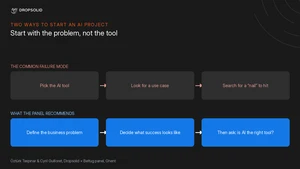
The consistent theme across the panel was that AI should never be the starting point of a strategy. Taspinar described the common failure mode as treating AI like a hammer and then searching the organization for a nail to hit, a pattern he'd seen before with blockchain, and with digitization initiatives before that. The organizations getting real value instead start from a specific business challenge, define upfront what success would look like, and only then ask whether AI is the right tool to get there.
Cyril Guilloret, drawing on three decades of experience working with data in banking, reinforced this from a different angle: the actual problem most companies have isn't a technology problem at all. It's that they haven't clearly defined where they want to compete and where they want to differentiate. AI, in his framing, is just one more enabler layered on top of a strategy, not a substitute for having one.
He also made a point worth sitting with: in financial services specifically, a large share of AI-driven value still comes from traditional machine learning, not from the recent wave of large language models.
A concrete example: the architect and the millimeter
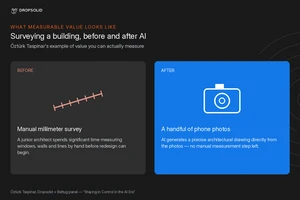
Taspinar offered a vivid illustration of what real, measurable value looks like. In the building and renovation sector, junior architects have traditionally spent significant time manually surveying an existing building, measuring windows, walls, and lines down to the millimeter before any redesign work can begin.
Today, that same process can be done by taking a handful of phone photos, uploading them, and letting an AI engine generate a precise architectural drawing at whatever level of detail is needed, with no manual measurement step left in the process.
That's the kind of change that's genuinely measurable: a task that used to take a defined amount of skilled human time now takes almost none, freeing that time for higher-value design work. Contrast that with an organization that can only report "we bought more licenses this quarter," one of these tells you something about value creation, and the other doesn't.
Rethinking work, not just adding a tool
Taspinar's broader argument was that the biggest opportunity isn't in cost-side use cases, the "where can I be faster or cheaper" projects most companies default to, but in genuinely rethinking business and operating models around what AI now makes possible.
hat means not copy-pasting old, inefficient processes into an AI wrapper and calling it transformation, but asking what the organization would look like if it were redesigned with these new capabilities in mind from the ground up.
The takeaway
The gap between organizations that see returns from AI and those that don't rarely comes down to which tools or models they've adopted. It comes down to discipline: defining success before you start, measuring outcomes rather than usage, accounting for the full cost of adoption rather than just the license fee, and being willing to redesign the underlying process rather than bolting AI onto something that was never built for it.
Licenses measure spend. They don't measure value. Until an organization can clearly answer what changed and by how much, it hasn't actually measured its AI investment, it's just tracked its bill.