AI self-service for visitors
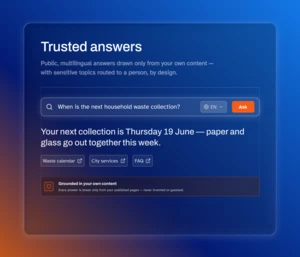
A multilingual AI conversational interface that answers your visitors using only your own published content with every answer carrying a citation they can click to verify.


Visitors can't find the right answer, so they leave or call.
Every organisation that publishes serves the same problem on repeat. Citizens, customers, candidates, patients ask the same procedural questions over and over: how do I read my meter, when does my recruitment competition close, what documents do I need, how do I update my billing details. The answers exist in published documents. The visitor can't find them. So the visitor calls. Each unnecessary contact costs €8–15. The team answers the same five questions all afternoon. The visitor experience drifts. The team burns out. The content exists; it just isn't findable in plain language.
Your content is there. It just isn't findable in plain language. And lost visitors are lost opportunities.

A notable increase in self-service usage
Visitors who find answers stay longer, trust more, and are twice as likely to convert. They engage more deeply with your content and create additional opportunities.
70% reduction in incoming questions
As seen in the case of EPSO.
20–40% uplift in self-service ratio
As seen in the case of EPSO.
Multilingual support
For all visitors in different regions.
Grounded answers, not generated guesses

Retrieval first, then generation
Generic AI conversational interface hallucinate because they generate. Trusted Answer retrieves first, then generates, anchoring every answer to a specific passage in a specific document on your site. The citation is part of the answer, so visitors can click through to verify it. Where no usable source exists, the system says so explicitly.Talk to your product pages
Visitors can talk with your product page to get cited answers drawn directly from your approved policy and product documents.How a question becomes an answer
The engine sends the visitor's question to the Dropsolid AI provider, which queries the LLM (model selectable via the model gateway). The LLM pulls context from the vector database and replies through the provider, which traces the exchange for audit, performance, and cost tracking. The engine returns the answer with citations and a confidence score.Full visibility for IT and Security
Your IT, Operations, and Security teams get usage and model cost tracking, input/output/context tracing, quality and performance evaluation, and feedback loops from both customers and experts for fine-tuning.
Pidpa: "Pip" answers a million citizens, grounded in Pidpa's own content
Pidpa is responsible for drinking water supply to households and businesses across Antwerp province. Citizens had high volumes of recurring questions. Pidpa deployed Trusted Answer — branded "Pip" — for citizens on the public website. Pip is live today. The full chain runs on EU-sovereign infrastructure.