Mention "digital sovereignty" in a boardroom and you'll often get one of two reactions: eye-rolling dismissal as a political buzzword, or an assumption it means building digital walls and going it alone. Jan Smedts, Head of Digitaal Vlaanderen, rejected both framings in his keynote at the Dropsolid x Beltug event in Ghent, and the panel that followed spent a good portion of the hour arguing about what the right alternative actually looks like.
Digital sovereignty isn't about isolation. It's about optionality
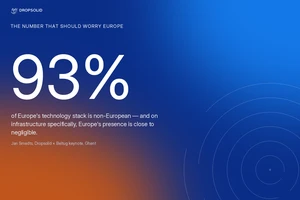
The number that should worry Europe
Smedts opened with a figure that's hard to argue with: roughly 93% of Europe's technology stack is non-European. Of the small remainder, most of it sits in telecom, thanks to companies like Nokia and Ericsson. On infrastructure specifically, Europe's presence is close to negligible.
That's not a moral failing, it's a strategic exposure. Smedts argued that sovereignty isn't about achieving self-sufficiency everywhere, which he called simply impossible. It's about understanding where your dependencies actually sit, and making a deliberate choice about which of them you're comfortable carrying and which ones you need a credible alternative to.
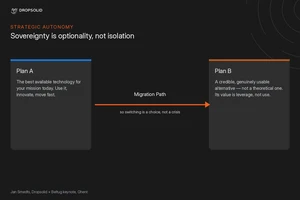
Plan A, Plan B, and negotiating leverage
The framework Smedts offered was simple: use the best available technology for your mission today (Plan A), but maintain a credible, genuinely usable alternative (Plan B), along with a real migration path between the two. The value of Plan B isn't that you expect to use it imminently, it's that having it changes your negotiating position. An organization with no viable alternative to a vendor has no leverage in that relationship. An organization with a credible Plan B does, even if it never activates it.
This point landed with particular weight given recent events: a brief regulatory disruption to access for certain frontier AI models made the abstract risk suddenly concrete for a room full of technology leaders. The lesson wasn't that any particular vendor is untrustworthy, it was that discovering you have no Plan B during an actual disruption is a far worse position than discovering it in a calm moment beforehand.
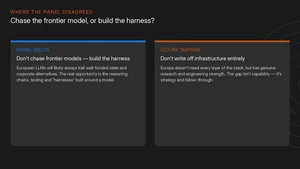
Where the panel disagreed: chase the frontier, or build the harness?
The most interesting tension of the afternoon came from a direct disagreement between Rafael Weuts and Öztürk Taspinar on where Europe's sovereignty efforts should actually go.
Weuts argued against chasing frontier foundation models as a sovereignty strategy. His reasoning: European efforts to build competitive large language models are likely, in his view, to always trail well-resourced open-source alternatives coming out of well-funded state or corporate programs elsewhere, simply due to the scale of resources involved.
Rather than compete on the model itself, he argued Europe's real sovereignty opportunity lies one layer up, in the reasoning chains, tooling, and "harnesses" built around a model. In his framing, a well-engineered system built around a widely available model can be just as trustworthy and effective as one built on a proprietary frontier model, because the differentiator isn't which base model you use, but the quality of the architecture, prompting, and context you wrap around it.
Taspinar pushed back with a nuance rather than a flat rejection. He agreed Europe doesn't need to compete on every layer of the stack, but was uncomfortable with writing off infrastructure investment entirely. He pointed to Europe's genuine strengths, including research institutions and companies with world-class capability, arguing that Europe has the underlying talent and technology but consistently fails to capture the value it creates.
The gap, in his view, isn't capability. It's strategy and follow-through.
The uncomfortable mirror: are we actually ready?
Later in the panel, Cyril Guilloret turned the sovereignty conversation onto the audience itself, pointing out that most people in the room likely use consumer platforms and tools from the same handful of large non-European providers every day, often without a second thought about the dependency involved. His point wasn't hypocrisy-shaming, it was that sovereignty, at the organizational level, ultimately comes down to individual behavior and awareness.
He shared an example from his own experience: even inside an organization that had built its own sovereign, in-house large language model specifically to keep data in-house, employees would sometimes photograph their screens and paste content into more familiar consumer AI tools, simply because those tools felt faster or more capable, and because staff hadn't been trained to understand the impact of that choice.
His conclusion: you can build all the technical firewalls you want, but if people aren't trained on why the sovereign alternative matters, and if that alternative is meaningfully less convenient, human habits will route around your controls every time.
Awareness as the actual bottleneck
A recurring thread across the panel was that sovereignty's biggest obstacle isn't technical at all, it's awareness. Several panelists pointed to practical tools that let organizations quickly assess their own exposure:
How dependent is your organization, really, on a single cloud provider or vendor?
Would you notice if that dependency were suddenly cut off?
For most organizations, the honest answer is that they've never actually checked.

The takeaway
Digital sovereignty, as this panel framed it, isn't a nationalist retreat from global technology, and it isn't a binary choice between "fully dependent" and "fully self-sufficient." It's a discipline: know where your dependencies actually sit, build a real (not theoretical) alternative for the ones that matter most, and invest in the organizational awareness needed to make that alternative something people will actually use when it counts.
Sovereignty isn't about having everything yourself. It's about never being left with no choice at all.