For the past few years, a lot of AI usage inside organizations has felt effectively free. Generous token allowances, subsidized access, aggressive land-grabs by providers competing for market share. At the Dropsolid x Beltug event in Ghent, several panelists warned that this phase is ending, and that most organizations haven't budgeted for what comes next.
The hidden cost of AI: Tokens, discount rates, and the bill nobody's budgeting for
"Somebody wants to earn a penny on that"
Jan Smedts, Head of Digitaal Vlaanderen, was the first to raise the alarm. His warning: the conversation that will define the next 12 months isn't about AI capability, it's about tokens and tokenization, and almost nobody in the room could confidently explain how pricing for that will evolve over even the next few months.
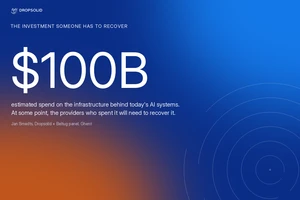
He put the scale of the underlying investment in stark terms: an estimated hundred billion dollars has gone into building the infrastructure behind today's AI systems, and at some point, the providers who spent that money will need to recover it.
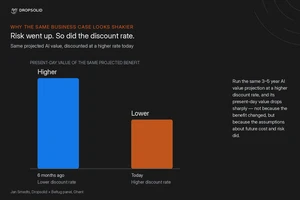
His sharper point was about how that cost shows up in financial terms. As the perceived risk around AI infrastructure and pricing has increased, so has the discount rate applied to business cases built around AI value.
Run a three-to-five-year value projection at a higher discount rate, and the present-day value of that projected benefit drops sharply, a business case that looked compelling six months ago can look far shakier today, purely because the assumptions about future cost and risk have shifted.
Free tokens aren't actually free
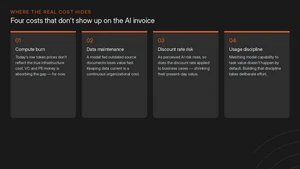
Öztürk Taspinar picked up this thread with a pointed observation: today's generous, low-cost (or free) token access doesn't reflect the true cost of running these systems. The infrastructure cost, and specifically the cost of the compute burn required to serve all that usage, isn't fully priced into what most organizations are currently paying. Private equity and venture capital are currently absorbing a significant share of that gap, funding usage growth ahead of sustainable pricing. That won't last indefinitely.
His own company's answer to rising compute costs was a physical one rather than a purely economic one: pairing AI compute with green energy sourcing, and capturing the heat generated by that compute and redirecting it into nearby buildings, rather than spending additional energy cooling it away.
He described a traffic-management approach to this, routing compute demand toward locations with surplus green energy or toward locations (like housing for elderly residents) where the waste heat itself has direct value. It's a reminder that "reducing the cost of AI" isn't purely a pricing or software problem, for organizations operating at real infrastructure scale, it's also a physical and logistical one.
The cost that isn't in the token price at all
Cyril Guilloret broadened the cost conversation beyond compute and pricing entirely. His argument: most organizations think about AI cost as ending once a tool is built and deployed. In reality, the ongoing cost of maintaining a model or tool, and, critically, maintaining the data feeding it, is a continuous cycle, not a one-time expense.
A chatbot fed outdated or poorly maintained source documents loses its value almost immediately, and keeping that data current is its own ongoing organizational cost, even if it never shows up on an invoice for AI usage itself.
His broader point was that this is a discipline still being built, not a solved problem. As costs rise, organizations will find ways to manage them, smaller, more efficient models, more selective use of expensive frontier capability versus cheaper alternatives for routine tasks, but that discipline doesn't exist yet in most organizations, and building it takes deliberate effort.
The behavioral upside of rising costs
Interestingly, several panelists suggested that rising token costs might have a genuinely positive side effect: forcing more deliberate usage. Roeland Delrue pointed out that as the cost of running AI queries becomes more visible and consequential, people will naturally start reserving higher-cost, higher-capability models for questions that actually warrant them, and defaulting to cheaper options for routine or low-stakes queries, a forced behavioral shift that arguably should have been happening all along, but wasn't, while usage felt free.
The takeaway
The organizations that will handle the coming shift in AI economics well are the ones treating cost as a design variable now, not a surprise later. That means building in awareness of true infrastructure and maintenance costs (not just license fees), applying realistic discount rates to AI business cases rather than assuming today's favorable pricing persists, and building the internal discipline to match model capability (and cost) to the actual value of each task.
The free-token era was never going to last. The organizations budgeting as if it will are the ones due for an unpleasant surprise.