Staying in control in the AI era: Recap of the Dropsolid x Beltug event

On July 2, 2026, senior technology and digital leaders gathered at The Plectrum in Ghent for an afternoon built around one deceptively simple question: how do you stay in control when AI is running the core of your organization?

What followed was less a series of polished presentations and more an extended, occasionally contentious, working conversation between people actually grappling with that question day to day.

Here's a full recap of how the afternoon unfolded.

Opening: Fourteen years, one birthday, and a founding bet on sovereignty

The afternoon opened with Dominique De Cooman, CEO of the Dropsolid group, marking an unusual milestone: July 2 was the first anniversary of Dropsolid AI, the group's newest company, but the broader story stretched back fourteen years, to when De Cooman and Steven Pepermans founded Dropsolid around the open-source Drupal content management system.

By 2018, working alongside then-CTO Nick Veenhof (now a director at GitLab), the company made a bet that looked unusual at the time: building an "open DXP," a digital experience platform that let customers keep full control over where their data lived, and embedding AI and machine learning into its personalization engine years before that combination became a mainstream conversation.

Their first major customer, secured with the help of an EU innovation grant, was the German government's federal labor agency, an early signal that sovereignty and AI would eventually become inseparable topics, long before most organizations were thinking that way.

De Cooman then handed off to Carlo Schots, CEO of Dropsolid Solutions, the group's services arm. Huts brought a commercial, street-level perspective: in his regular conversations with business leaders, he's found that most companies are doing something with AI, but when pressed on whether it's actually moved the needle on revenue or profit, the room usually goes quiet.

His diagnosis was that most AI initiatives stall in the proof-of-concept phase, held back less by the technology itself than by security concerns, compliance uncertainty, and a general reluctance to commit. His challenge to every executive he meets: if there were no restrictions at all, what's the one AI use case that would meaningfully transform your company's performance?

Everyone, he noted, already knows the answer, they just haven't acted on it. Huts shared two concrete proof points for what's possible when organizations do act: helping the European Personnel Selection Office manage a weekly volume of thousands of job applications reduce manual processing work by 93% within two months, and helping the Port of Antwerp improve customer service response quality while lowering cost-to-serve.

He closed by unveiling Dropsolid's rebranded logo, concentric open circles meant to evoke a ripple effect, symbolizing the company's open-source, community-oriented philosophy.

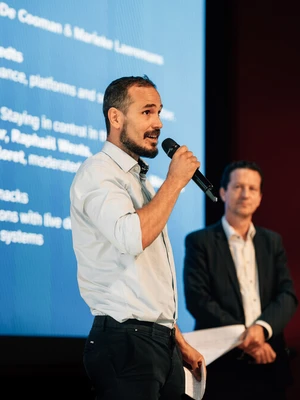
Marieke Laeremans, project manager at Beltug (the Belgian association of CIOs, CTOs, and digital technology leaders), introduced Beltug's mission, informing, connecting, and representing business technology users, and framed the shift Beltug has observed across its membership: AI has moved from an innovation topic to a governance, accountability, risk, and increasingly sovereignty topic.

She highlighted two mindset shifts organizations need to make: rethinking processes from the ground up rather than simply plugging AI into existing workflows, and treating AI as an enterprise-wide concern involving HR and legal, not solely an IT initiative.
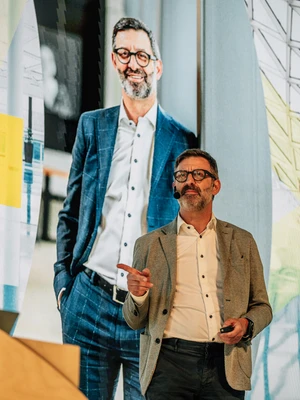
Keynote: "AI on Your Terms" by Jan Smedts, Head of Digitaal Vlaanderen

The keynote from Jan Smedts set the intellectual tone for the rest of the afternoon. His opening statistic was blunt: roughly 67% of people are already using AI, while only around 18% of organizations (per McKinsey) have a governance framework in place, adoption everywhere, control nowhere.

He argued that AI is fundamentally a "dependency multiplier": it doesn't create new organizational weaknesses so much as it ruthlessly exposes and deepens existing ones in infrastructure, data governance, and architecture. More than half of organizations, he noted, have already experienced a negative AI-related incident in the past year.

His proposed framework for regaining control centered on strategic autonomy through optionality, not isolation, but the ability to choose. That means maintaining a Plan A (the technology actively in use), a credible Plan B (a genuine alternative), and a clear migration path between the two. He connected this directly to recent, real-world turbulence: a brief regulatory disruption affecting access to certain frontier AI models, which underscored, in real time, exactly the kind of dependency risk he was describing.

On cybersecurity, Smedts reported a three-fold increase in external attacks over the past two years, but argued the bigger danger is internal: organizational complexity, architectural fragmentation, and the accumulation of one-off exceptions and custom integrations, a "spaghetti" of systems nobody fully understands.

His answer is platformization: Flanders' "Government OS" approach, a shared foundation spanning network, hosting, data, and workflow layers, that lets teams build on top without re-solving foundational security and integration problems each time.

He closed with a call for European collaboration through a "coalition of the willing," public and private organizations moving forward together rather than waiting for consensus among all 27 EU member states, which he argued Europe no longer has the luxury of waiting for.

Panel discussion: Staying in control in the AI era


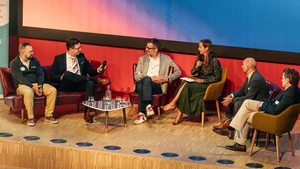
Following the keynote, Smedts was joined on stage by Öztürk Taspinar, Rafael Weuts (AI governance advisor and former academic), Roeland Delrue (co-founder, Aikido Security), and Cyril Guilloret (advisor, banking sector), moderated by Marlène de Wouters. The conversation ranged widely, and several distinct threads emerged:

On failure and lessons learned: Weuts described a real project at RIZIV (the Belgian healthcare department) where AI successfully fixed a flawed medical guideline search system, only to run into the EU AI Act's high-risk classification once patient-specific advice was involved, a certification path not yet ready, requiring a pragmatic workaround.

Delrue shared Aikido's own multi-attempt journey building AI-powered customer support, which took roughly six to seven months and two full pivots before adoption actually stuck.

Smedts, referencing a recent MIT study finding 95% of AI projects fail, offered his now-memorable framing: AI adoption often looks like installing a powerful sports car in a traffic jam, the real fix is 70% about people, 20% about change management, and only 10% about the technology itself.

On measuring value: Taspinar and Guilloret both warned against measuring AI success by inputs (licenses purchased, tokens consumed) rather than outcomes. Taspinar's example of AI-assisted architectural surveying, turning a manual, millimeter-precise measurement task into an automated photo-based process, illustrated what genuinely measurable value looks like, while Guilloret noted that in financial services, much of AI's real value still comes from traditional machine learning rather than the newest generative models.

On digital sovereignty: Weuts and Taspinar disagreed productively on where Europe should focus its sovereignty efforts, Weuts arguing Europe is unlikely to out-compete well-resourced foundation models and should instead focus sovereignty efforts on the tooling and reasoning "harnesses" built around models, Taspinar countering that Europe has genuine research and infrastructure strengths it consistently fails to capitalize on.

Guilloret turned the mirror on the audience, noting how easily consumer habits (using familiar big-tech tools instead of sanctioned sovereign alternatives) undermine even well-intentioned sovereignty efforts, sharing an example of employees photographing screens to paste content into more familiar AI tools despite having an in-house sovereign alternative available.

On open source: Delrue detailed both the strategic upside of open source (transparency, community trust, competitive positioning) and its real risks, the significant variation between license types, and a cautionary story about a company that used ambiguous open-source licensing to pursue payment claims against unsuspecting businesses, including major airlines.

On security: Guilloret and Delrue disagreed on how much AI has genuinely changed the threat landscape, Guilloret arguing the underlying vulnerabilities were always there and AI simply accelerates discovery, Delrue arguing the scale is unprecedented and most patching cycles haven't kept pace. Both agreed that fighting AI-driven threats with AI-driven defense, and not neglecting security basics, is the most practical path forward.

On cost: Smedts, Taspinar, and Guilloret each flagged different dimensions of AI's true cost, rising token pricing and its effect on business-case discount rates, the still-unpriced infrastructure and compute costs behind today's "free" usage, and the often-overlooked ongoing cost of maintaining data quality behind any AI system.

The panel closed with Weuts raising the concept of instrumental convergence and the broader AI safety debate, and each panelist offering closing thoughts, from Guilloret's optimism about incorporating AI into how we live and work, to Taspinar's personal anecdote about restructuring his own children's subscriptions to prioritize AI literacy over entertainment streaming.

Hands-on session and closing remarks

The afternoon closed with a hands-on session exploring observability and governance in practice, moving the conversation from theory to a live demonstration of an AI agent project, offering attendees a tangible look at what it actually means to trace, monitor, and govern an AI system in real time.

Dominique De Cooman closed the formal program by returning to open source as Dropsolid's core belief and the foundation of true sovereignty, noting the company's continued investment in the Drupal AI initiative and inviting attendees to explore the platform hands-on with the Dropsolid team.

Daniel Jakobs of Beltug added a closing note on Eurocom, a newly launched European initiative to build shared European solutions for directory services, telecommunications, and cloud infrastructure, an invitation for organizations in the room to get directly involved in shaping Europe's collective digital sovereignty path over the months ahead.

The thread that tied it all together

Strip away the individual topics, governance, cost, security, sovereignty, open source, and one thread ran through nearly every conversation of the afternoon: control is not something organizations lose to AI by accident. It's something they hand over by failing to ask hard questions early enough, about dependencies, about what "success" actually means, about who's accountable when something goes wrong, and about whether there's a real alternative if today's default choice stops working.

Nobody on stage offered a simple fix. What they offered instead was a shared, hard-won honesty about where the real work lies, and a clear sense that the organizations willing to do that work now will be the ones still standing, and still in control, when the next disruption arrives.

See it live