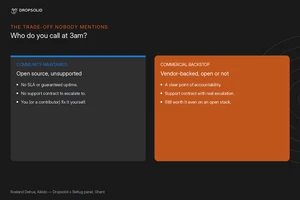
But treating "open source" as a simple, low-risk default would be a mistake, and Roeland Delrue, co-founder of the cybersecurity company Aikido, used his time on the panel to explain why.
Aikido uses open source extensively, both defensively and strategically. Some of their own security tooling is deliberately open-sourced for transparency, so customers can see exactly what they're integrating into production systems, which matters a great deal when the software in question sits inside live, sensitive environments.
In other cases, Aikido has open-sourced a tool specifically to undercut a competitor charging heavily for something similar, a calculated business move rather than a purely philosophical one.
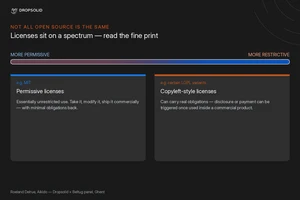
Delrue's caution was about the fine print. Open-source licenses vary enormously in what they actually permit, and getting this wrong carries real consequences. Permissive licenses (like MIT) allow essentially unrestricted use. Others, like certain LGPL variants, can carry obligations, for instance, requiring payment or disclosure once the software is used in a commercial product, even if it was free for private use.
Keeping track of every license across a software stack (something often referred to as a software bill of materials) becomes critical during events like M&A due diligence, when legal teams comb through exactly what open-source components a company relies on and under what terms.