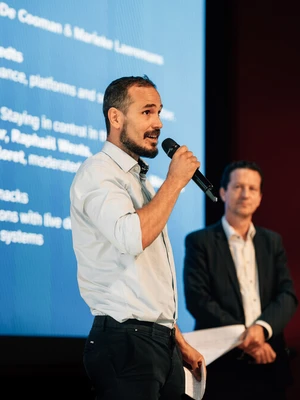
The afternoon opened with Dominique De Cooman, CEO of the Dropsolid group, marking an unusual milestone: July 2 was the first anniversary of Dropsolid AI, the group's newest company, but the broader story stretched back fourteen years, to when De Cooman and Steven Pepermans founded Dropsolid around the open-source Drupal content management system.
By 2018, working alongside then-CTO Nick Veenhof (now a director at GitLab), the company made a bet that looked unusual at the time: building an "open DXP," a digital experience platform that let customers keep full control over where their data lived, and embedding AI and machine learning into its personalization engine years before that combination became a mainstream conversation.
Their first major customer, secured with the help of an EU innovation grant, was the German government's federal labor agency, an early signal that sovereignty and AI would eventually become inseparable topics, long before most organizations were thinking that way.
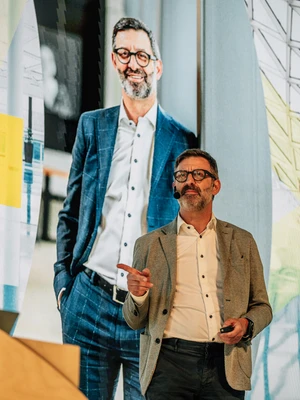
De Cooman then handed off to Carlo Schots, CEO of Dropsolid Solutions, the group's services arm. Huts brought a commercial, street-level perspective: in his regular conversations with business leaders, he's found that most companies are doing something with AI, but when pressed on whether it's actually moved the needle on revenue or profit, the room usually goes quiet.
His diagnosis was that most AI initiatives stall in the proof-of-concept phase, held back less by the technology itself than by security concerns, compliance uncertainty, and a general reluctance to commit. His challenge to every executive he meets: if there were no restrictions at all, what's the one AI use case that would meaningfully transform your company's performance?
Everyone, he noted, already knows the answer, they just haven't acted on it. Huts shared two concrete proof points for what's possible when organizations do act: helping the European Personnel Selection Office manage a weekly volume of thousands of job applications reduce manual processing work by 93% within two months, and helping the Port of Antwerp improve customer service response quality while lowering cost-to-serve.
He closed by unveiling Dropsolid's rebranded logo, concentric open circles meant to evoke a ripple effect, symbolizing the company's open-source, community-oriented philosophy.
Marieke Laeremans, project manager at Beltug (the Belgian association of CIOs, CTOs, and digital technology leaders), introduced Beltug's mission, informing, connecting, and representing business technology users, and framed the shift Beltug has observed across its membership: AI has moved from an innovation topic to a governance, accountability, risk, and increasingly sovereignty topic.
She highlighted two mindset shifts organizations need to make: rethinking processes from the ground up rather than simply plugging AI into existing workflows, and treating AI as an enterprise-wide concern involving HR and legal, not solely an IT initiative.