Why Dropsolid is helping lead AI Search in Drupal

By Niels Aers

On the 23rd of July, the Inside AI team shared where AI inside Drupal is heading. It began with a simple question that Christoph Breidert and I put to the Drupal AI Partners: of everything we could build inside Drupal, what do you want most? One answer stood out above the rest. Search.

We were not surprised. And we could not be happier to say that Dropsolid is stepping up to help lead the AI Search work for the initiative.

We want to be clear about what that means, because it matters to us. Leading in an open-source project is not the same as owning something. It is doing the work in the open, keeping a public backlog that other contributors can pick up, and building alongside people who are just as invested.

The AI Search area already has strong leads in Abhisek Mazumdar and Laurens Van Damme, and the invitation stays open for anyone who wants to join them. We are not planting a flag. We are rolling up our sleeves.
The world searches differently now


Here is why search feels like the right place to put our energy.

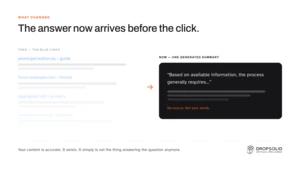
The way people look for answers has quietly changed. A few years ago, someone with a question typed it into a search box, scanned a page of blue links, and clicked through to a website to read the answer for themselves. That habit is fading. More and more, the answer arrives before the click: a summary written by a large model, sitting at the top of the page, stitched together from sources the reader never visits.

It is convenient. It is also a shift in who gets to answer questions about you. When a visitor asks about your product, your policy, your service, or their rights as a citizen, the reply increasingly comes from a model trained and tuned by a handful of very large technology companies. Sometimes it is right. Sometimes it is confidently wrong. Either way, the answer about your organisation is no longer coming from your organisation.

For anyone who publishes with care, whether you are a public institution, a hospital, a utility, a university, or a company with a shelf of product documentation, that is worth sitting with. Your content is accurate. It exists. It simply is not the thing answering the question anymore.

Give people the truth, straight from the source

AI Search inside Drupal is our response to that.

The idea is to give your own visitors the modern search experience they now expect, an AI-written summary with the sources behind it, but grounded entirely in your own published content, on your own site. Not the open web filtered through someone else's model. Your words, your documents, your voice.

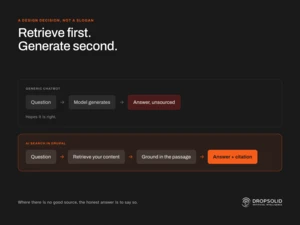
This is the part we care about most, and it is a design decision rather than a slogan. A generic chatbot generates first and hopes it is right, which is why it hallucinates. The approach we have been building retrieves first and generates second. Every answer is anchored to a specific passage in a specific document you published, and the citation travels with the answer so the reader can click through and check it. Where there is no good source, the honest thing is to say so rather than invent one.

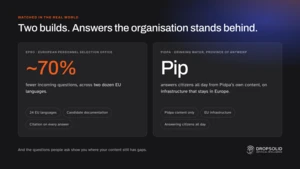
We have watched this work in the real world. For EPSO, the European Personnel Selection Office, we built a solution that cut incoming questions by around 70 percent across two dozen EU languages. For Pidpa, the drinking-water company for the province of Antwerp, we built an assistant named Pip that now answers citizens all day using nothing but Pidpa's own content, on infrastructure that stays in Europe. Both were custom builds, and both paid off. Every one of those answers is one the organisation is happy to stand behind, because it came from the organisation.

There is a second benefit, less obvious than the first. When you can see the questions people actually ask, you can see the questions your content does not yet answer. AI Search does not only serve your visitors. It shows you where your own information has gaps, so you can close them.

From two custom builds to open source


Those two projects were custom work, and they taught us a great deal. The obvious question afterwards was what to do with what we had learned. We could have kept it. We decided to give it back.

So we are taking the lessons from EPSO and Pidpa and open-sourcing the approach inside Drupal, rebuilt to belong to the Drupal AI ecosystem rather than to sit beside it, using its agents, its guardrails, and the shared foundations the initiative is putting in place. A rising tide lifts every boat. When AI Search is strong in Drupal itself, every team and every agency that builds with Drupal gets better at this, and so do the organisations they serve. That is the whole point of an open initiative: a capability like this becomes part of the CMS itself, auditable and portable, within reach of everyone who builds with Drupal, rather than the private feature of one vendor's stack.

Which makes our job as a lead a practical one. Groom the issues. Keep the backlog clear enough that a new contributor can find something to work on before their coffee goes cold. Start with what can ship now, the Drupal-native case where the content already lives in Drupal and the path from question to cited answer is short. Tune it against real, realistic content until the results are genuinely good, then help fold it into the single site the initiative will show at DrupalCon Rotterdam in September, next to the chatbot, content review, and translation work.

When you want it fully managed: Trusted Answers


The open base is there for everyone, and that is how it should be. Running it well in production is its own kind of work, though. It means choosing and updating models, keeping answers accurate as your content changes, watching cost, and proving quality to the people who sign off on it.

Seeing what EPSO and Pidpa needed is exactly what inspired us to build a dedicated product for teams who would rather have that handled: Trusted Answers, a fully managed AI search built on the same open base.

Here is what the managed product adds on top of the open foundation today:

  • We pick the models. You get the right model for the job whether it’s for embedding, re-ranking, guardrails or returning the answer. We keep them current as the landscape shifts, so you are never re-platforming to chase the state of the art.
  • A clear, predictable cost. You pay for answers given, not for a black box, so cost tracks value and stays easy to forecast.
  • Observability through Langfuse, the strongest AI observability layer in the market. Every answer is traced, so quality, cost, and performance are visible rather than guessed at.
  • Answers beyond Drupal. When the question calls for it, Trusted Answers can also draw on other public sources you approve, not only your Drupal content.

Two more capabilities are close behind, and we are building them now:

  • Content-gap reports you can act on. We are adding an LLM-as-a-judge layer that will evaluate the answers your visitors receive and surface where your content falls short, turning a pile of raw questions into a short list of things to fix.
  • Automatic evaluation that keeps learning. The system will review its own responses and improve over time, so you get close quality control without anyone having to read every question and answer by hand.

None of that competes with the open work. It sits on top of it. The base makes Drupal AI Search better for everyone. Trusted Answers is for the teams who want it run for them, to a standard, with the numbers to prove it.

Come build it with us

If any of this speaks to you, we would love your help. Search improves fastest when more people bring their content, their languages, and their edge cases to it. You can find the work in the #ai-initiative channel on Drupal Slack, and you are welcome whether you want to lead a corner of it or just fix a single issue.

And if you publish anything worth reading, wherever you publish it, it is worth asking what it would mean to let your visitors hear the truth from you. Not from a search box you do not control. From the source. From you.

That is the opportunity we see, and we are grateful to be building it in the open.